
The Point of Aim may be defined as that point in the distance which, when sighted over the tip of the drawn arrow, will cause the arrow to fly to the center of the target, provided the loose and other conditions are perfect.
In general, the archer does not sight at the center of the target. For a particular bow and arrow there is but one shooting distance where the point of aim and the center of the target are the same. For all other distances, the point of aim is either above or below the center of the target. It may be on the ground in front of the target for the shorter distance and it may be a point in a tree top, for example, behind the target for the greater distance. These phenomena are due to the fact that the eye is above the arrow and that the arrow flies in a decided curve for the longer distances.
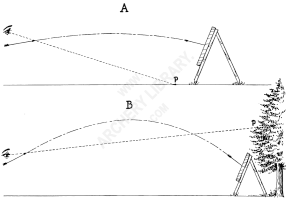
Suppose a 45-pound bow with an arrow of average weight is shot at a target 40 yards distant. Figure 39, A, is intended to illustrate what takes place. The eye, being above the arrow, sees a point P on the ground over the tip of the arrow while, in fact, the arrow is so pointed that when loosed it will hit the center of the target. So when shooting a 45-pound bow at 40 yards, a point must be found to sight at below the target instead of on it. This is the "point of aim" which is found by trial shots and may be identified by a bright-colored marker. For weaker bows, the point of aim rises until it may be actually on the target. A bow short of full draw produces the result of the weaker bow, so the importance of the same length of draw for each loose is clear.
At 100 yards the point of the arrow is elevated to lengthen the trajectory, Figure 39, B. Under these circumstances, the point of aim is likely to be above the target, say in a tree or other tall object. If there is nothing tall enough behind the target, the archer is simply "out of luck" and must do the best he can by sighting at an invisible point a certain number of estimated diameters above the target, or shoot by instinct. We are not giving consideration here to any special sighting device which may be attached to the bow as an aid to long-distance shooting.